

If your facility still relies on a mop and a broom to keep floors clean, you’re not alone — and you’re not doing anything wrong. For a lot of businesses, that’s just how it’s always been done. But if cleaning is tying up staff for hours every day — or getting skipped altogether on busy days — there’s a better way, and it might be more accessible than you think.
Commercial floor scrubbers and sweepers aren’t just for big-box retail or massive distribution centers. They’re used every day in warehouses, manufacturing plants, auto shops, agricultural operations, and food processing facilities across the Pacific Northwest — many of which didn’t realize this kind of equipment was an option for an operation their size.
The Real Cost of Manual Cleaning
Mopping and sweeping by hand isn’t free — it just doesn’t show up on an invoice. Instead, it shows up in staff hours that could be spent elsewhere, in inconsistent cleaning results from one shift to the next, and in floors that never quite look as clean as you’d like.
Right now, your employees who are scrubbing a floor with a mop, or sweeping up debris with a broom, can cover roughly 4,000 square feet per hour.1
Although that might seem like a decent amount, it’s a fraction of what Kärcher commercial floor care equipment can cover. By comparison a base-model walk-behind machine can cover 3.5 to 7.5 times more ground than a mop or broom — and ride-on models go far beyond that
- Scrubbers: 13,995 – 64,045 ft²/hr
- Sweepers: 30,100 – 75,577 ft²/hr
That difference in cleaning coverage is, in plain terms, the difference between labor lost to your floors and labor returned to your business.
Commercial Floor Scrubbers and Sweepers: Cut Cleaning Time and Labor Costs in Your Facility
What That Means for Your Bottom Line
For a practical comparison, let’s say your facility is 4,000 square feet. What would have taken your team about an hour by hand can be done in about 17 minutes with an entry-level walk-behind scrubber, or about 8 minutes with an entry-level sweeper — and that difference adds up fast.2
Over the course of a year, that time savings translates directly to your bottom line:3
- Small facility (2,000–5,000 sq ft, typical of many independent auto shops): roughly $4,100 to $5,000 in annual labor savings with a walk-behind machine
- Larger facility (~17,400 sq ft, U.S. average for warehouse and storage buildings): roughly $17,800 to $21,600 a year with a walk-behind machine — and ride-on models can push that even further
And here’s the part that often surprises people: walk-behind scrubbers and sweepers generally pay for themselves in labor savings alone within 1 to 2 years. After that, it’s pure time and money back in your pocket, year after year.
Savings Estimator
To help put these numbers in context for your specific situation, we’ve selected a range of Kärcher models across both scrubbers and sweepers. Keep in mind that each model has its own unique features and configurations that can affect the price point — our Product Specialists are always happy to help you find the right fit for your application
| Model | Time to Clean | Time Saved | Annual Labor Savings* |
Approx. Payback |
|---|
*Based on $22/hr labor rate (WA median wage for material handlers, based on the most recently available WA ESD 2025 OEWS data), 260 working days/year, manual rate of ~4,000 sq ft/hr. Loading current pricing…
| Model | Time to Clean | Time Saved | Annual Labor Savings* |
Approx. Payback |
|---|
*Based on $22/hr labor rate (WA median wage for material handlers, based on the most recently available WA ESD 2025 OEWS data), 260 working days/year, manual rate of ~4,000 sq ft/hr. Loading current pricing…
Beyond the Numbers
There’s also a simpler benefit that’s easy to overlook: consistency. A machine cleans the same way every time, regardless of who’s running it or how the rest of the day is going. For facilities where appearance matters — whether that’s customers walking through, inspectors stopping by, or just pride in how the place looks — that consistency adds up over time.
Many Kärcher machines reinforce that consistency with the EASY!Operation control panel — simple, symbol-based controls that ensure the same cleaning mode is selected the same way every time, with no guesswork from one operator or shift to the next. New operators can be up and running in minutes, not days.
Furthermore, a couple of design details make a real difference day to day, too: scrubbers pick up dirty water as they go for floors that are clean and dry almost immediately, and sweepers with sealed filter systems capture fine dust instead of kicking it back into the air.
Plus, Northstar actively supports service and stocks Kärcher wear parts — brushes, squeegees, filters, and more — on the equipment we sell so the machine you invest in today keeps running the way it should for years to come. That’s a level of support you’re not going to find from an online-only store.
Scrubbers and Sweepers: Two Different Jobs
It’s worth knowing the difference between the two main types of equipment Kärcher offers for floor care, because most facilities can benefit from both.
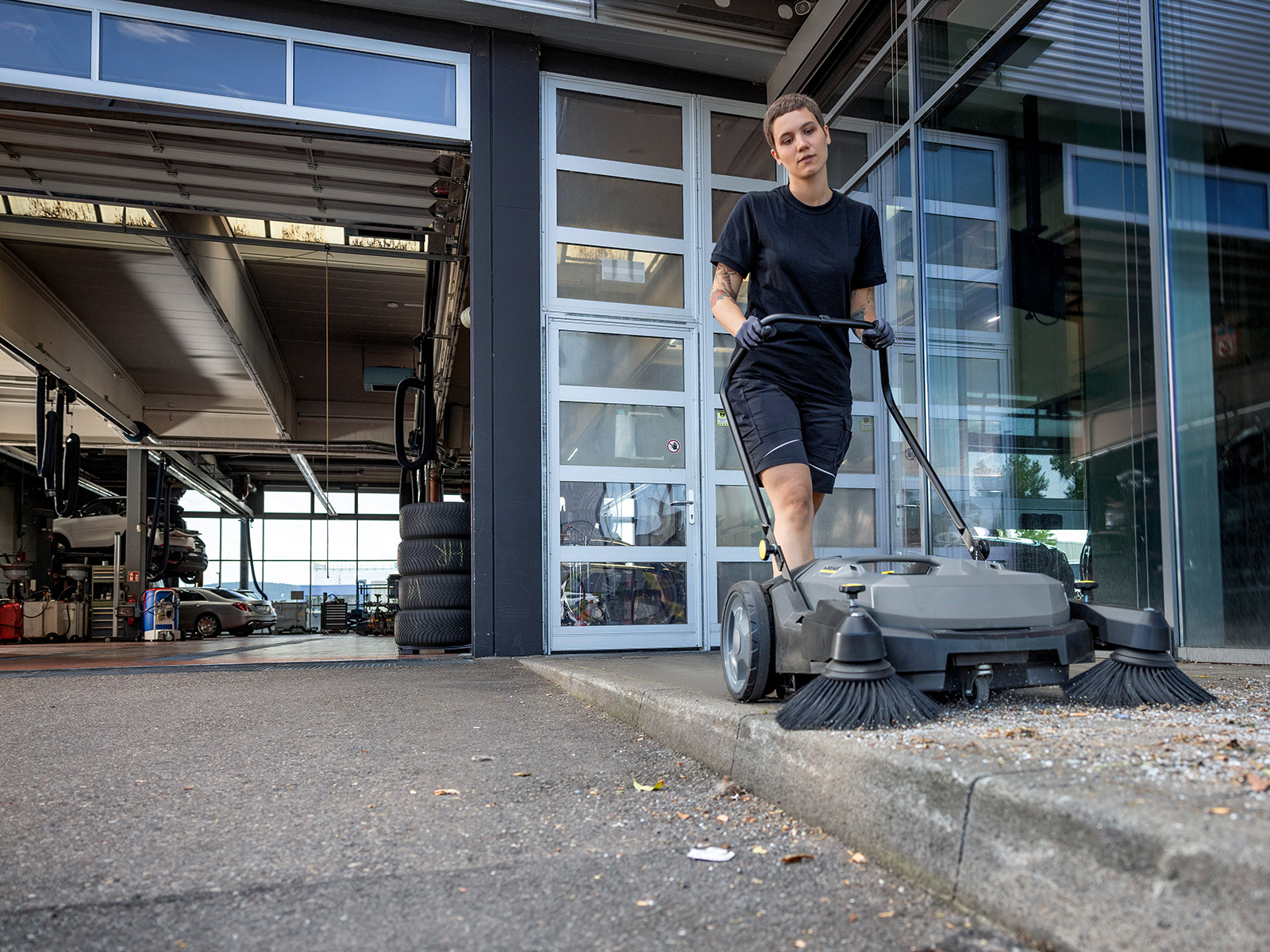
- Floor Sweepers pick up dry debris, dust, and loose material — the kind of mess that builds up from foot traffic, forklift activity, or material handling. Keeping dry debris under control also helps prevent it from scratching floors or becoming a slip hazard once it mixes with any moisture.
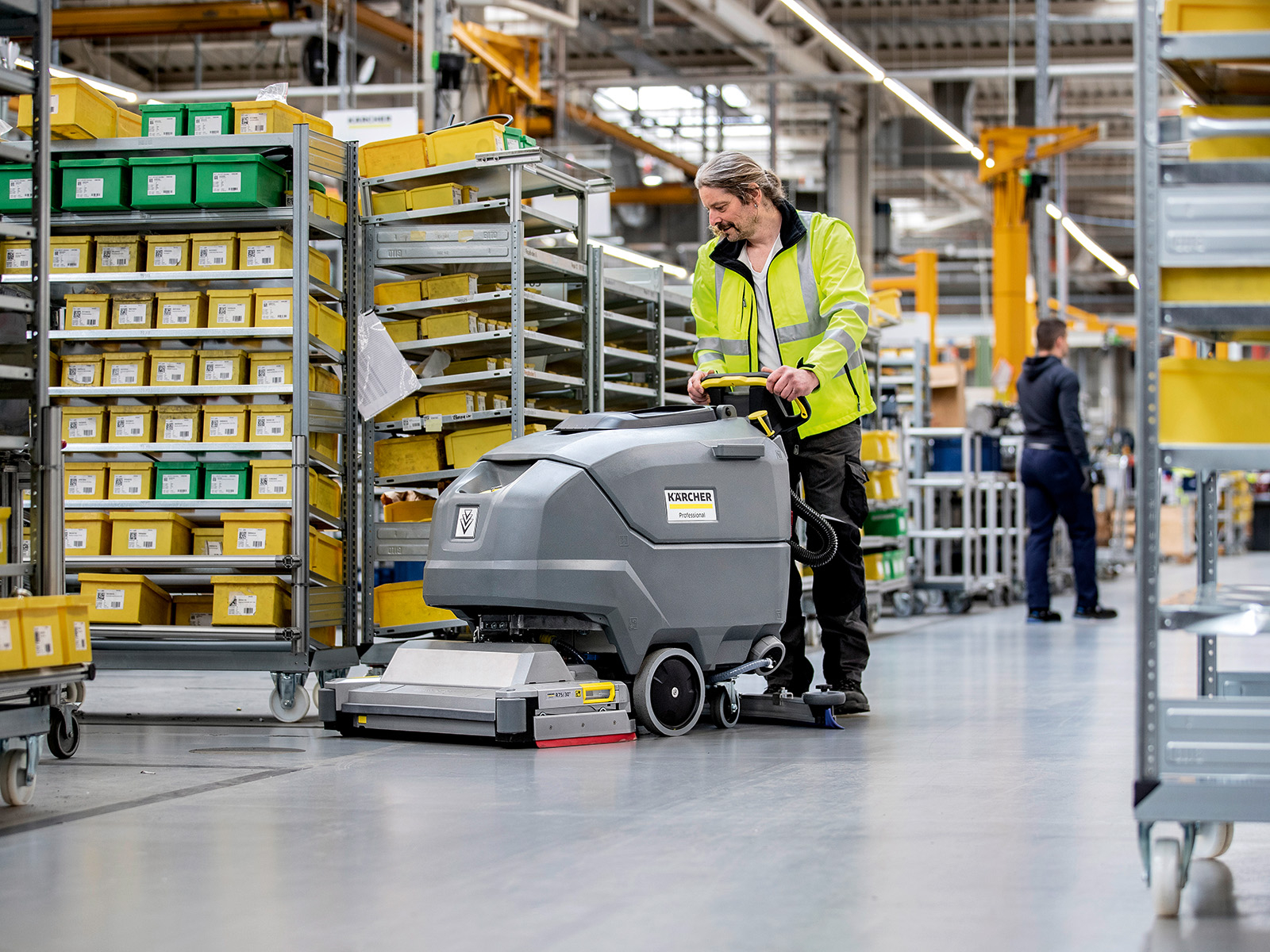
- Floor Scrubbers handle wet cleaning — washing, scrubbing, and picking up dirty water in a single pass. They’re the right tool for grease, chemical residue, spills, and general grime that a sweeper can’t address.
Used together, they cover the full range of what a commercial floor actually deals with day to day.
Northstar Can Help
If any of this sounds like it could apply to your facility, the right scrubber or sweeper depends on a few things — your floor type, square footage, the kind of debris or residue you’re dealing with, and how your team operates day to day. That’s where a little guidance goes a long way.
Northstar Clean Concepts is here to help you find a model built for your facility — from compact units for tight spaces to walk-behinds and ride-ons for larger areas — and the right brush, pad, and other configurations for your floor type and the debris or residue you’re cleaning up.
We have been helping Pacific Northwest businesses find the right Kärcher cleaning equipment for the job since 1979 — with the knowledge, experience, and parts and service support to stand behind it long after the sale.
If you’re ready to see what floor care equipment could do for your facility, reach out to one of our Product Specialists.
¹ ~4,000 sq ft/hr is a conservative estimate based on commonly published manual cleaning production rates for commercial facilities.
2 A walk-behind scrubber (BD 50/50 C Bp Classic) covering up to 13,995 sq ft/hour reduces cleaning time to about 17 minutes, and a walk-behind sweeper (KM 70/20 C) covering up to 30,100 sq ft/hour reduces it to about 8 minutes, based on a 4,000 sq ft facility.
3 Based on $22/hr labor rate (WA median wage for material handlers, based on the most recently available WA ESD 2025 OEWS data), 260 working days/year. Small facility range (2,000–5,000 sq ft) reflects the 2022 Ratchet+Wrench Industry Survey of independent auto shops; large facility size (~17,400 sq ft) reflects the U.S. average for warehouse and storage buildings per EIA CBECS 2018.